
When taking a turn,for a vehicle with more than two tires(cars,autorickshaws,trains etc.,),the outer wheel has to cover more distance than the inner wheel.
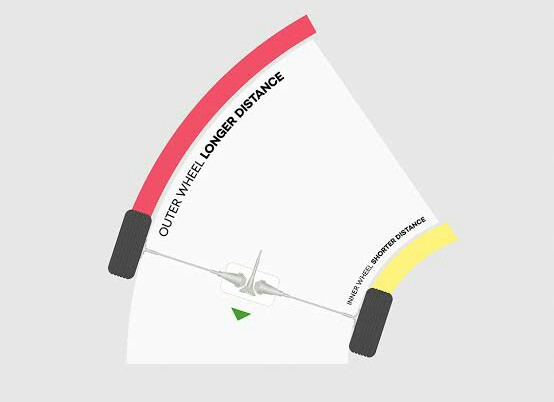
If the two wheels are rotating at same speed,then one of the wheel will get slipped,dragged instead of rotating.It may cause failure of rear axle.
To avoid that,the outer wheel has to rotate faster than inner wheel,so that both will cover their respective distances without slipping in the same time.
In automobiles,during a turn,to make the inner wheel and outer wheel rotate at different speeds,a set of gears called Differential is employed.
But in trains,ther is no such thing called as differential.
Then how did the trains take turn without slipping? How did they achieve different speeds on outer and inner Wheels?
The principle lies in the design of train wheels.
The shape of the wheels are conical (frustum),which ensures the required function.
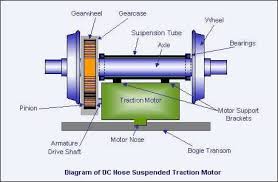
Working:
Consider the train taking a right turn.
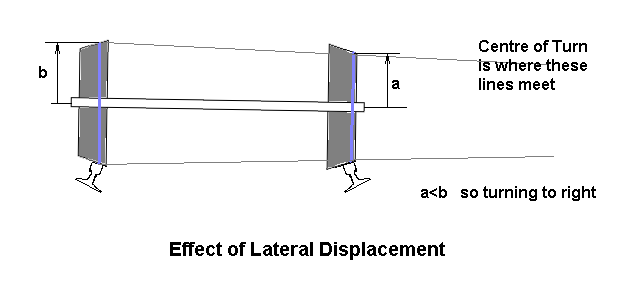
While taking the right turn,axle itself shifts towards left on the tracks.Then,the right side inner wheel rotates on a lesser wheel radius whereas the outer left wheels rotate on larger wheel radius.(in fig.)
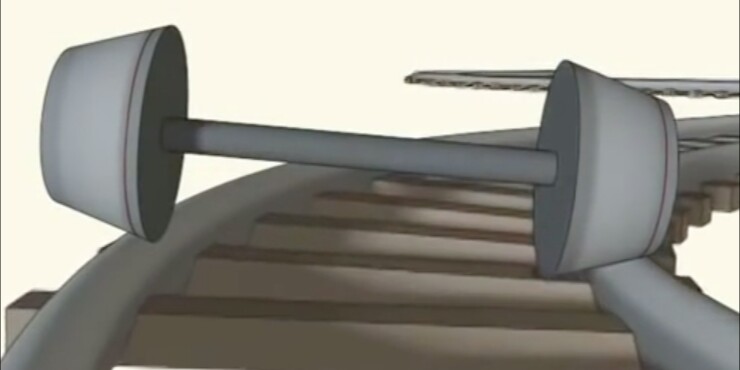
When,the right side wheel rotates on lesser radius,velocity will be less.
Whereas the left side outer wheel will be rotating on a larger diameter,hence with more velocity.Thus acheiving the required difference in speeds.
So,a simple change in design saved a lot of space and money.
For visual explanation:
Thank you.
 Science Around You